
From Pellets to Fabric: How a Nonwoven Fabric Machine Works
A nonwoven fabric machine turns polypropylene pellets into a continuous roll of fabric in one uninterrupted sequence: the pellets are melted and extruded into fine filaments, the filaments are laid down into a loose web, the web is bonded into a stable sheet, and the finished fabric is wound, slit and packed. No yarn is spun and no weaving takes place at any point in that sequence — the filaments bond directly to one another, which is what makes the material 'nonwoven'.
For a first-time buyer, that sequence is more useful than any model code. Layer names such as SS or SMMS, quoted speeds and width ranges only make sense once you can see which stage of the process each of them controls. This explainer follows the four core stages — feeding, extruding, web forming and bonding — in the order they happen on a real line, and connects each stage to the decisions a buyer actually has to make.
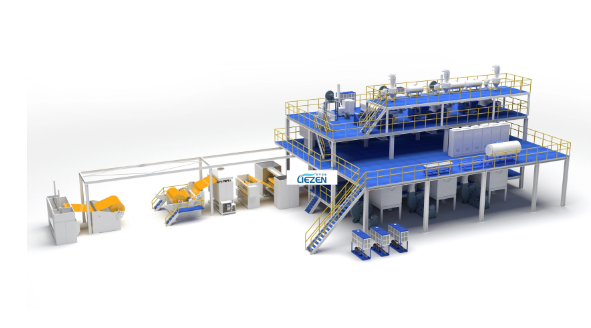
A spunbond nonwoven fabric machine: the fabric-forming section of an integrated nonwoven production line.
Problem Definition: Why the Process Comes Before the Purchase
Most first-time buyers meet a nonwoven machine through a quotation rather than through a factory. The quotation lists models, widths, speeds and layer counts, and the buyer is expected to know which combination fits the product they intend to make. That gap between a model code and a real production line is where most evaluation mistakes begin.
Three misunderstandings are common enough to name:
- A nonwoven fabric machine is one machine. In practice it is an integrated production line: a feeding and dosing section, an extruder, one or more spinning beams, a web-forming belt, a bonding unit, and auxiliary devices that include traction units, winding and rewinding equipment, fans and air compressors, heating and temperature control, and slitting, cutting and packaging modules.
- The line is the whole factory. A nonwoven fabric machine produces the substrate. Converting that substrate into masks, diapers, sanitary napkins, wipes or bags is a separate downstream step with different equipment. Buyers who mix the two end up comparing quotations that describe different scopes of supply.
- A higher quoted speed means higher output. Output is the product of effective width, fabric gram weight and actual running efficiency. A line's maximum production speed and its dependable day-to-day speed are not the same number, and the difference usually appears in the specification sheet rather than in the headline figure.
Understanding the process converts all three problems into questions a buyer can ask: which stages does the quoted scope actually cover, what is the effective width and layer structure, and what fabric weight range is the line set up to run.
Industry Background: Why Spunbond-Based Lines Lead the Market
The demand picture explains why spunbond-based lines are the usual starting point for new projects. The global nonwoven machinery market was valued at USD 6.8 billion in 2025 and is projected to reach USD 12.1 billion by 2034, according to Dataintelo. Within that market, spunbond machinery held the largest share of nonwoven equipment at 34.2% in 2025. On the fabric side, spunlaid (spunbond) technology accounted for 48.4% of the global nonwoven fabrics market share in 2023, based on Grand View Research data.
Regionally, Asia Pacific held a 43.7% revenue share of the nonwoven machinery market in 2025 (Dataintelo), with demand driven by hygiene products and medical-grade materials (MarketsandMarkets). China's nonwoven fabric output reached 8.56 million tons in 2024, a 5.1% year-on-year increase, and the country exported 1.52 million tons valued at USD 4.04 billion (CNITA / China Customs). Spunbonded nonwovens accounted for 37% of that export value, and China's spunbonded output alone was 3.88 million tons in 2024, up 4% year on year (CNITA).
Two material and application facts shape the process itself. Polypropylene remains the dominant raw material for spunbond nonwoven production, accounting for over 53% of the segment in 2026 (Fortune Business Insights). And disposable products — hygiene, medical and similar single-use goods — take approximately 59.8% of the nonwoven market (Grand View Research). That is why the standard technical discussion almost always begins with a PP spunbond line.
The spunbond technology market is projected to grow at a CAGR of 6.20% from 2026 to 2034 (Fortune Business Insights). Machinery ordered today is expected to stay in service across that period, which is a practical reason to understand the process rather than only the price.
Detailed Solution: What Sits Inside a Nonwoven Fabric Machine
A nonwoven production line is a chain of modules, each performing one transformation and handing the material to the next. Polymer goes in at one end; a finished roll of bonded fabric comes out at the other. The configuration families in current commercial use include Single S, SS, SSS, meltblown, SMS, SMMS, SSMS and SMMSS spunbond lines, as well as PET and bi-component nonwoven machines. Polypropylene is the main raw material for both spunbond and meltblown processes, while the equipment itself is built mainly from carbon steel, stainless steel, alloy parts and electrical components.
Lizen Machinery Co., Ltd. is a nonwoven machinery manufacturer based in Changzhou, Jiangsu, China, founded in 2003. The company operates a 30,000 m² facility with 270 employees and an R&D team of 10 engineers, and produces roughly 50 units per year; about 60% of its output is exported, with the United States as its main market. Lizen reports that it has supplied close to 1,000 complete sets of standardized and customized nonwoven production lines in 30 countries, covering PP spunbond lines in Single S, SS, SSS, meltblown, SMS, SMMS, SSMS and SMMSS configurations as well as PET and bi-component machines. The lines are supplied under the SEEK WINWIN brand and presented through lizen-equipment.com.
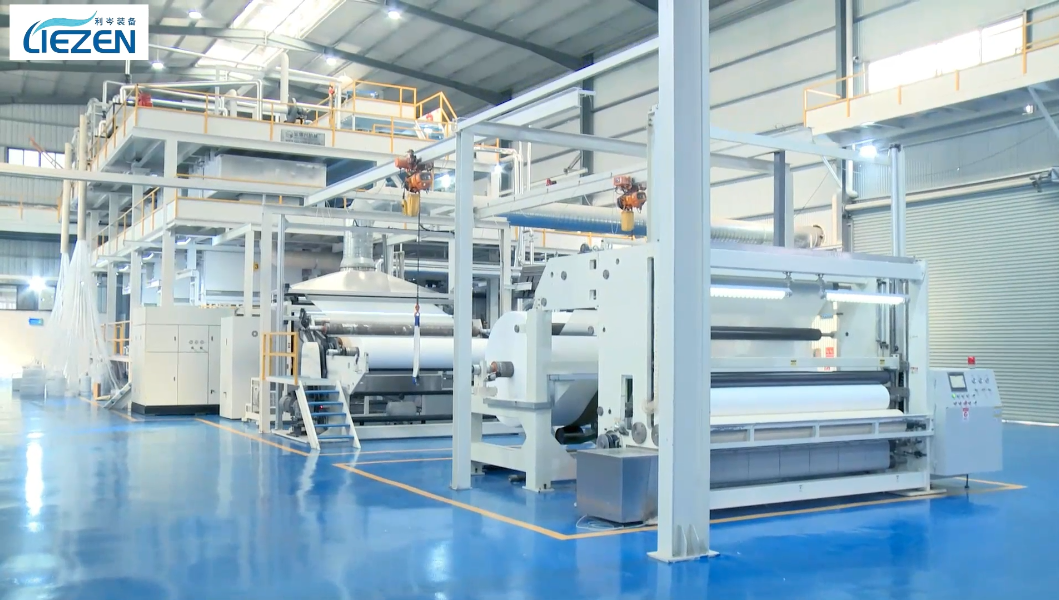
Inside a nonwoven production line: the machine operates as a connected chain of modules, not as a single stand-alone unit.
Step-by-Step Breakdown: From Pellets to Finished Roll
Step 1 — Raw material feeding
The process starts with polymer, not with fibre. Polypropylene pellets are metered into the extruder at a controlled rate. Because the fabric's gram weight is essentially a function of how much polymer enters the system per square metre of web, feeding accuracy is the first place where fabric consistency is decided. Additive options can be introduced at this stage depending on the project: Lizen's lines can support custom requirements such as different widths, layer counts, electrostatic treatment, flame-retardant options and medical-grade clean standards.
Step 2 — Extrusion and melting
Inside the extruder, the pellets are heated until they become a homogeneous melt. Temperature control is the critical variable at this point: an inconsistent melt produces an inconsistent filament, and filament inconsistency shows up later as uneven fabric. Lizen's lines use a matched closed temperature control system, which the company links to a higher finished-product qualification rate.
Step 3 — Filtration and spinning
The melt passes through filtration and is then pushed through a spinneret — a plate perforated with many fine holes. The filaments that emerge are cooled by air and drawn down to the required fineness. Filament fineness is quoted in denier and varies by configuration: Lizen's lines are specified at 1.5–2.5D on the SW-SSS model and 1.5–2.0D on the SW-SS and SW-SMMS models.
Step 4 — Web forming
The drawn filaments fall onto a moving belt and are laid down as a continuous, loose web. The number and type of spinning beams determine how many layers that web contains: a line with two spunbond beams forms an SS structure, three spunbond beams form SSS, and a spunbond–meltblown–meltblown–spunbond stack forms SMMS. Lizen's SW-SS model is described as a double-beam PP spunbond nonwoven fabric machine, which is exactly this principle: two beam positions, one layered web.
Step 5 — Bonding
The web leaving the forming belt has almost no mechanical strength — it is a mat of loose filaments. Bonding is the stage that turns it into fabric. In spunbond lines this is typically done by passing the web through a heated calender, where filaments fuse at their crossover points under controlled heat and pressure. Meltblown layers, made from much finer filaments, are generally consolidated differently and are most often used inside an SMS or SMMS structure to contribute barrier properties rather than structural strength. Bonding quality determines how the finished roll behaves in downstream converting.
Step 6 — Winding, slitting and packaging
Once bonded, the fabric runs through traction units and winding or rewinding equipment, then through slitting, cutting and packaging modules. These are auxiliary devices rather than the core of the process, but they set the roll format your downstream operation will receive — roll width, roll diameter and package handling all come from this section.
Step 7 — In-line checks and acceptance
Quality is verified both during and after production. Lizen's lines can support in-line output and quality checks while running. Before shipment the machine goes through factory acceptance testing (FAT) and performance or process testing; after installation at the customer's site, on-site installation and acceptance (SAT) confirms the line performs as specified in the real production environment.
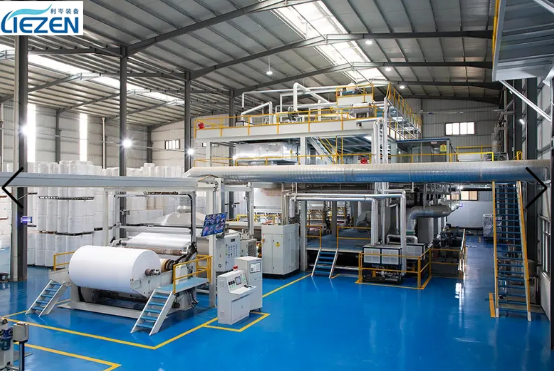
An actual machine view: the extrusion, spinning and web-forming sections run as one continuous process.
Use Cases: Matching the Process to the Product
Because every configuration shares the same four stages, the differences between projects appear in the layer structure, the width, the auxiliary modules and the downstream requirements — not in the basic principle.
- Medical and hygiene. Masks, protective wear, sanitary napkins and diapers are the largest application group. The line supplies the substrate; downstream converting equipment, such as a sanitary napkin nonwoven fabric machine, turns that substrate into the finished product. Medical-grade work may require a cleanroom environment rather than a standard workshop.
- Automotive interior. The global automotive nonwoven market reached USD 3.6 billion in 2025, with needlefelt as the leading technology (Stratview Research). Spunbond-based automotive interior nonwoven production lines supply liner substrates, and are usually paired with slitting and winding modules that deliver rolls in the format the interior trim process expects.
- Apparel and home textiles. Interlinings, protective covers and textile components use lighter fabric weights, where web uniformity matters more than line speed.
- Agricultural covers. Crop and soil covers place the emphasis on width and on tensile behaviour rather than on barrier properties.
- Packaging and eco-friendly bags. Nonwoven bags and packaging materials are typically produced from mid-weight PP spunbond fabric, where the stability of gram weight directly affects the appearance and strength of the finished bag.
Project types follow the same logic. Lizen supplies turnkey production lines, single machines, and process modification or upgrade projects for existing lines. The company's equipment is delivered to markets that include the United States, India, Saudi Arabia, Pakistan, Thailand, Vietnam and the United Kingdom. For continuous industrial operation, the line is configured for uninterrupted running with a level of automation and online monitoring that depends on the customer's requirements.
One reference point for durability comes from a client in Pakistan operating two units in nonwoven substrate and mask filter media production: the equipment has been in service for 15–20 years, and the reported result is improved capacity and product consistency, with the ability to adapt to different nonwoven recipes.
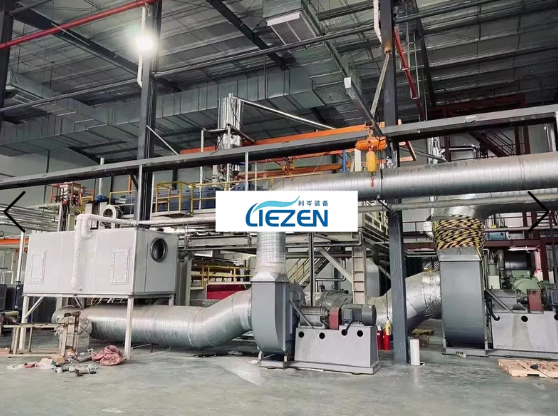
On-site installation and commissioning: the process is verified in the customer's own production environment.
Comparison Table: SS, SSS and SMMS Line Configurations
The table below compares three configurations that use the same working principle but differ in web structure and speed range. All figures are quoted per model and apply to the SEEK WINWIN line range from Lizen Machinery Co., Ltd.
| Configuration | Model | Web structure | Effective width | Production speed | Mechanical speed | Filament fineness |
|---|---|---|---|---|---|---|
| SS (double beam) | SW-SS | Two spunbond beams | 1600–3200 mm | Below 250 m/min | Below 300 m/min | 1.5–2.0D |
| SSS (three beam) | SW-SSS | Three spunbond beams, automatic SSS spunbonded polypropylene fabric making | 1600–3200 mm | Below 400 m/min | Below 450 m/min | 1.5–2.5D |
| SMMS (spunmelt) | SW-SMMS | Spunbond, meltblown, meltblown, spunbond | 1600–3200 mm | Below 400 m/min | Below 450 m/min | 1.5–2.0D |
Which parts of the process can be customized
The four working stages stay the same in every project. What changes is how each stage is sized and instrumented, and that is where a buyer's requirements enter the design.
| Configurable item | What it changes in your project |
|---|---|
| Web (effective) width | Determines the roll width you can deliver and how many downstream products can be cut from one web. |
| Capacity (kg/h or m/min) | Sets the output target the line is designed around, independent of the maximum speed figure. |
| Layer count | Defines the web structure — SS, SSS, SMS, SMMS, SSMS, SMMSS — and therefore the fabric's strength and barrier behaviour. |
| In-line testing and QC | Moves quality verification from the end of the run into the running process. |
| Automation and HMI | Changes how much of the line an operator supervises directly and how much is monitored online. |
| Material handling modules | Adapts feeding, winding and transfer to the roll format and raw-material handling you already use. |
| Special process options | Electrostatic treatment, flame-retardant options and medical-grade clean standards are configured at the order stage, not added later. |
FAQ
What safety and quality standards apply to a nonwoven fabric machine?
Two standards are directly relevant to nonwoven machinery. ISO 11111-3:2005 sets the safety requirements for nonwoven machinery, while general safety requirements for textile machinery — including nonwoven lines — fall under EN ISO 11111-1:2016 for CE marking compliance in Europe. On the quality-management side, ISO 9001 certification is standard practice for top-tier nonwoven machinery manufacturers in China. Because the applicable standard depends on where the line will be installed and what it will produce, buyers should confirm the required standard for their destination market as part of the technical agreement rather than after delivery.
Can one nonwoven fabric machine produce different layer structures or fabric types?
Yes, within the limits of the line's design. Lizen Machinery's range covers Single S, SS, SSS, meltblown, SMS, SMMS, SSMS and SMMSS configurations as well as PET and bi-component machines, and the layer structure is set by the number and type of spinning beams installed. Customizable items include web width, capacity in kg/h or m/min, layer count, in-line testing and QC, automation and HMI, and material handling modules. Effective width across the standard models runs from 1600 to 3200 mm. What a single line cannot do is switch freely between fundamentally different layer structures, because the beam configuration is a hardware decision taken at the order stage.
What has to be settled before requesting a quotation for a nonwoven production line?
The configuration. A quotation is only comparable when the scope of supply is defined, and the scope is defined by the products you intend to make, the fabric weight range, the effective width, the layer structure, the target production speed, the automation level, the auxiliary and downstream modules (winding and rewinding, slitting and cutting, packaging, heating and temperature control, fans and air compressors), and whether the project is a turnkey line, a single machine, or a modification and upgrade of an existing line. Lizen's minimum order quantity for a nonwoven production line is 1 unit, and its lines support custom requirements including different widths, layer counts, electrostatic treatment, flame-retardant options and medical-grade clean standards.
How can a buyer verify the process before the line is installed?
Through acceptance testing. Lizen's lines can support in-line output and quality checks during production, and each machine goes through factory acceptance testing (FAT) and performance or process testing before shipment. After delivery, on-site installation and acceptance (SAT) is carried out at the customer's plant. After-sales support covers installation and commissioning, on-site training, spare parts supply and remote technical support.
How long does a nonwoven fabric machine take to deliver?
Lizen's production capacity is 4 units per month. Lead time is 1–3 months in the off season and 3–6 months during peak season, measured from order confirmation to shipment; installation, commissioning and operator training follow on site. Because that range is wide, the practical approach is to request a delivery schedule together with the quotation and align it with your own project timeline. To start, send your product and capacity requirements to Lizen Machinery Co., Ltd. at managerl@lizen-equipment.com or on WhatsApp at +86 188-8818-2509.
Conclusion
A nonwoven fabric machine does four things, in the same order, on every line: it feeds polymer, melts and extrudes it, forms a web, and bonds that web into fabric. Everything that differs between one quotation and another — the number of beams, the width, the speed range, the bonding unit, the automation level, the auxiliary modules — is a variation on those four stages, not a different process.
For a buyer in the research and evaluation stage, that process map is the tool that turns a specification sheet into a decision. Read the layer structure first, then the width and speed, then the auxiliary scope, then the acceptance and service terms. If a proposal cannot be explained in those terms, the technical conversation is not finished yet.
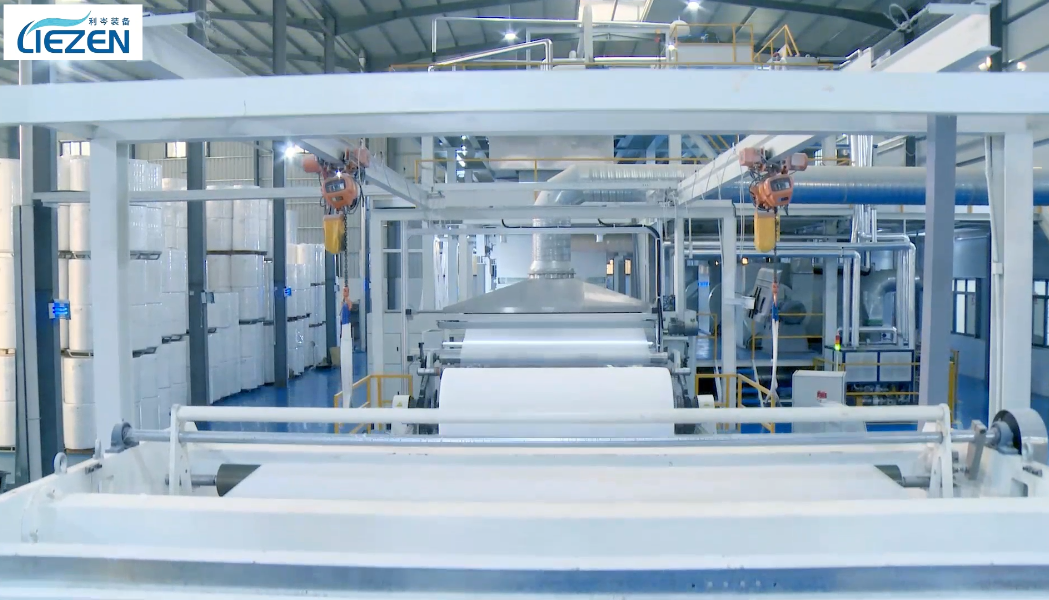
From polymer to roll: a nonwoven production line in the workshop.
Next Step: Check the Process Against Your Product
Lizen Machinery Co., Ltd. builds PP spunbond, spunmelt, SMS and meltblown nonwoven production lines in Single S, SS, SSS, SMMS, SSMS and SMMSS configurations, together with PET and bi-component machines.
Website: www.lizen-equipment.com
Email: managerl@lizen-equipment.com
Tel / WhatsApp: +86 188-8818-2509
Address: No. 6 Jingye Road, Qianhuang Town, Wujin District, Changzhou, Jiangsu, China
Send your target product, fabric weight and required width, and the configuration review can be matched to the process stage that governs it.
Have Questions or Need More Details?
Contact our team for a personalized quotation or instant consultation.
Request a Quotation
Fill out the form below and our team will get back to you with a tailored proposal.
WhatsApp Direct Chat
Prefer to chat in real-time? Message us on WhatsApp for instant assistance & quick answers.
- Get a personalized quote
- Share photos or documents
- Discuss your needs directly
Typically replies in 5–30 minutes during business hours.