Nonwoven Machine vs. Nonwoven Fabric Machine: A Glossary
Short answer: in most equipment catalogues, nonwoven machine is the umbrella term for the whole equipment family — the line that forms the fabric plus the machinery that slits, laminates or converts it. Nonwoven fabric machine is the narrower term for the fabric-forming line itself: the equipment that turns polymer or fibre into a bonded web and delivers it as a roll. The two labels are frequently used interchangeably in trade listings, but they are not interchangeable in a request for quotation or a purchase contract, because they describe two different scope boundaries.
This article is a vocabulary reference, not a machine ranking. It defines the category terms, shows where each term sits in the production chain, and translates the vocabulary into the purchasing and acceptance language a buyer needs at quotation, contract and commissioning stage. The terms covered here — nonwoven machine, nonwoven fabric machine, nonwoven making machine, nonwoven production line, spunbond nonwoven machine, PP spunbond nonwoven machine, SMS nonwoven machine, spunmelt machine, automotive interior nonwoven production line and sanitary napkin nonwoven fabric machine — are the words that most often decide whether a supplier and a buyer are discussing the same scope.
Why the two labels get confused
The confusion is structural rather than careless. Both labels share the same category noun, and both are used by suppliers, trading companies and search engines for pages that describe very different equipment.
- The category is one family with several stages. Nonwoven manufacturing runs from polymer handling through web forming and bonding to winding, and then continues into off-line processing and conversion. A single catalogue category usually lists all of these stages together.
- Translation compresses the words. Machinery categories translated from Chinese trade language often collapse “fabric forming” and “fabric processing” into one label, so the English page title and the English quotation can describe different machines.
- Search behaviour mixes the terms. A buyer looking for a full line and a buyer looking for a converting machine can type the same phrase, so suppliers optimise one page for both.
- Umbrella words survive into contracts. Once an umbrella label is copied into a purchase order, scope gaps appear later — at inspection, at shipment or at commissioning.
Three practical risks follow from this. First, a scope mismatch: the buyer expects a complete line and receives the forming section only, or the reverse. Second, a comparison error: two quotations are compared side by side even though one covers fabric forming and the other covers downstream conversion. Third, acceptance ambiguity: test criteria are written for a machine that is not the machine being delivered.
Industry background: why the vocabulary now carries commercial weight
Nonwoven machinery is a large and still expanding equipment category. The global nonwoven machinery market was valued at USD 6.8 billion in 2025 and is projected to reach USD 12.1 billion by 2034, according to Dataintelo. The same source reports that Asia Pacific dominated the market with a 43.7% revenue share in 2025, and that spunbond machinery held the largest share of the nonwoven equipment market at 34.2% in 2025.
The fabric side of the chain shows the same scale. China’s nonwoven fabric output reached 8.56 million tons in 2024, a 5.1% year-on-year increase, and China exported 1.52 million tons of nonwovens in 2024, valued at USD 4.04 billion, according to China Customs and CNITA data. Spunbonded nonwovens accounted for 37% of China’s nonwoven export value in 2024. On the material side, polypropylene remains the dominant raw material for spunbond production, accounting for 53.92% of the segment in 2026, per Fortune Business Insights, which also projects a 6.20% CAGR for the spunbond technology market from 2026 to 2034.
Two consequences follow for terminology. Because the market is dominated by a handful of process families, the umbrella word “nonwoven machine” now covers a very wide price and capability range, which makes precision more valuable, not less. And because public sources identify leading global players such as Reifenhäuser Reicofil GmbH and Andritz AG (Dataintelo, 2025) alongside a large Chinese manufacturing base, buyers routinely compare offers from suppliers whose catalogues use different terminology conventions.
Terminology note: the existence of a safety standard for the category confirms how broad the category is. Safety requirements for nonwoven machinery are governed by ISO 11111-3:2005 (Textile machinery — Safety requirements — Part 3: Nonwoven machinery), and general textile machinery safety requirements, including nonwoven lines, fall under EN ISO 11111-1:2016 for CE marking compliance in Europe.
The category vocabulary, term by term
The table below sets out what each commonly used label usually means in trade usage, and the one question that resolves the ambiguity before a quotation is issued.
| Term | What it usually refers to | What to confirm before quoting |
|---|---|---|
| Nonwoven machine | Umbrella term for the whole equipment family: fabric-forming lines plus slitting, rewinding, laminating and converting machinery. | Which machines sit inside the battery limit — forming only, or forming plus downstream processing and conversion. |
| Nonwoven fabric machine | The line that converts polymer or fibre into a bonded web and winds it into fabric rolls. | Whether slitting, rewinding and any off-line treatment are part of the offer or a separate package. |
| Nonwoven making machine | Informal synonym used in trade listings, most often for a complete fabric-forming line. | Treat it as a synonym for nonwoven fabric machine unless the offer states a wider scope. |
| Nonwoven production line | Emphasises the line as an integrated system rather than a single unit. | The full line configuration and the interface list between sections. |
| Spunbond nonwoven machine | A line in which filaments are spun, laid into a web and bonded; the backbone process family for polypropylene-based fabrics. | The bonding method and the layer structure the line is built for. |
| PP spunbond nonwoven machine | The same process family with polypropylene named explicitly as the raw material. | Which polymer the line is configured for. PP accounts for 53.92% of the spunbond segment in 2026 (Fortune Business Insights). |
| SMS nonwoven machine | A line configured to run a spunbond–meltblown–spunbond composite, where SMS describes the layer structure rather than a single bonding method. | Layer structure, and whether the meltblown section is integrated in-line. |
| Spunmelt machine / spunmelt nonwoven machine | Collective label for processes that spin filaments directly from polymer and form them into a web; spunbond and meltblown are the two members of this family. | Ask the supplier to name the exact process instead of accepting the umbrella word. |
| Automotive interior nonwoven production line | An application word: a line specified around automotive interior components rather than around a generic fabric. | The process family, because automotive nonwovens are not served by one technology — needlefelt is described as the leading technology in that segment by Stratview Research. |
| Sanitary napkin nonwoven fabric machine | A trade phrase that combines a fabric process with a hygiene end product. | Whether the supplier means a fabric-forming line feeding a napkin converter, or the converting machine itself. |
Two of these terms deserve a separate sentence because they are the most common source of mismatch. Spunmelt is a family word, not a configuration: a spunmelt nonwoven machine may be a pure spunbond line, a meltblown line, or a composite line. SMS is a structure word: it specifies the layer sequence, which is why an SMS offer should always be read together with a layer drawing.
Where the two terms sit in the production chain
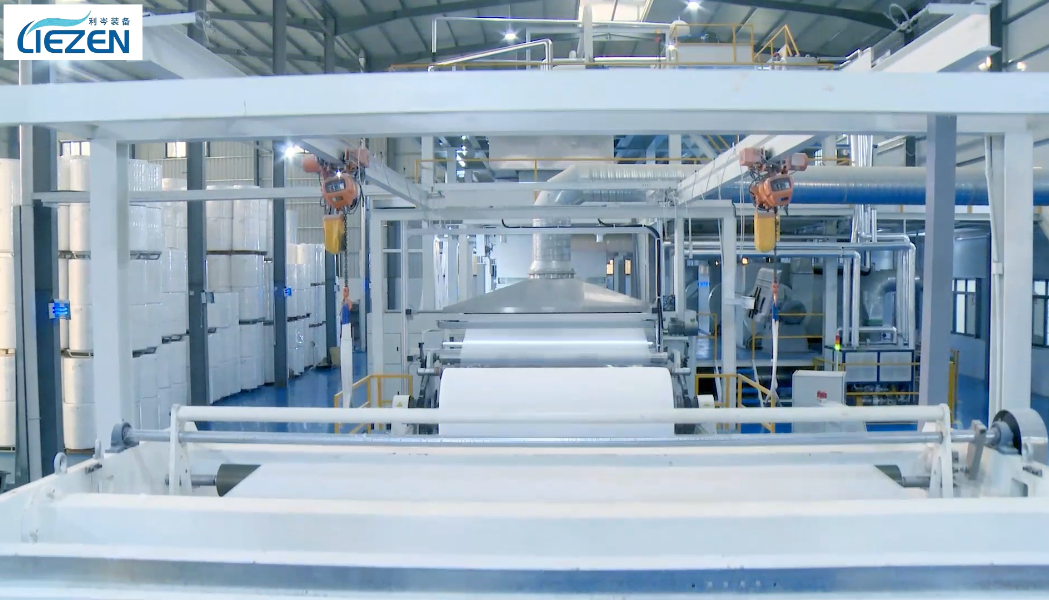
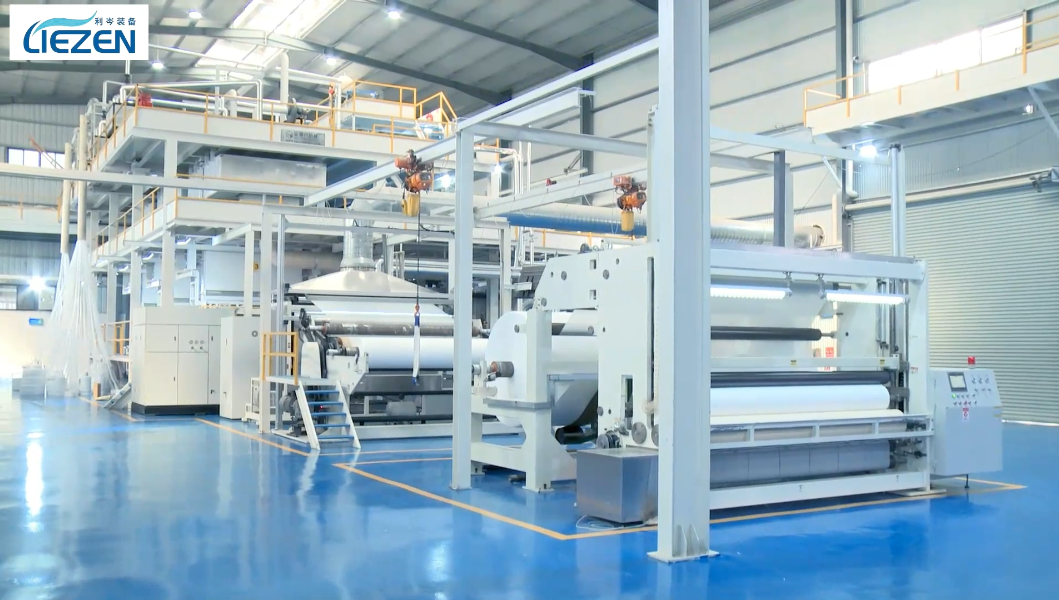
A simple chain diagram resolves most of the ambiguity. Everything up to the fabric roll belongs to the “nonwoven fabric machine” scope; everything from the fabric roll onward belongs to the wider “nonwoven machine” scope.
- Polymer and raw material handling — feeding, drying and dosing of the polymer or fibre input.
- Filament spinning or fibre preparation — extrusion and spinning in spunbond and meltblown processes.
- Web forming — laying the filaments or fibres into a continuous web.
- Bonding — consolidating the web into fabric.
- Winding — the end of the fabric-forming scope; the output is a fabric roll.
- Off-line processing — slitting, rewinding, lamination and surface treatment, often supplied as separate units.
- Conversion — machines that turn fabric into finished products such as sanitary napkins or wipes; these are “nonwoven machines” but not “nonwoven fabric machines”.
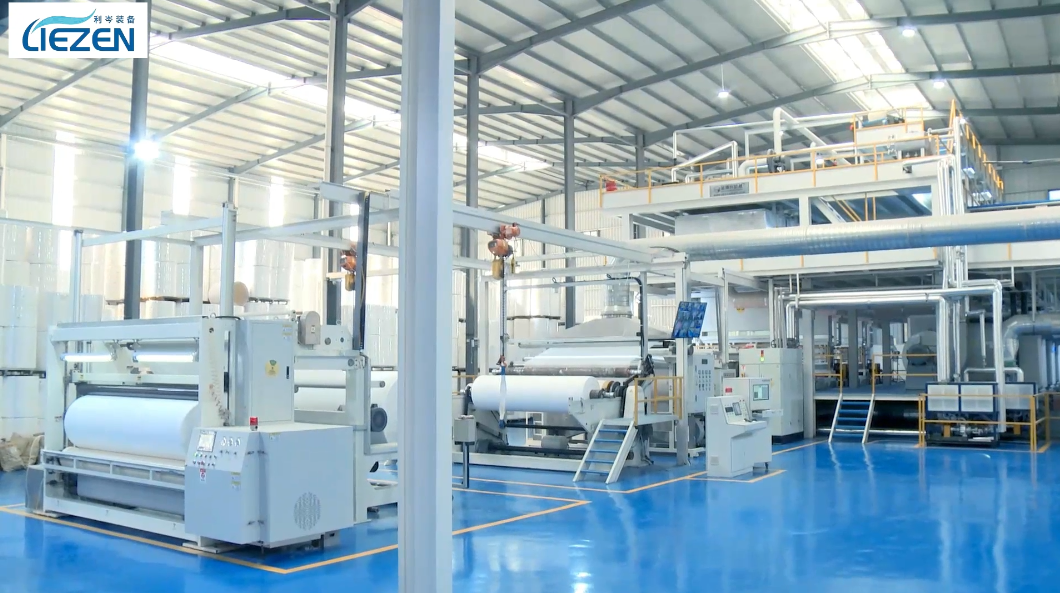
Within this chain, Lizen Machinery Co., Ltd. (registered as Changzhou LieZen Non-woven Machinery Co., Ltd.) works on the fabric-forming side. Founded in 2003 and based in Changzhou, Jiangsu, China, the company manufactures PP spunbond nonwoven fabric machines covering Single S, SS, SSS, meltblown, SMS, SMMS, SSMS and SMMSS configurations, as well as PET and bi-component nonwoven machines, and reports close to 1,000 complete standardized and customized nonwoven production lines supplied across 30 countries, from a 30,000 m² facility with 270 employees, 10 R&D engineers and an annual output of 50 units. That product list is a useful illustration of the vocabulary point: the company name contains “non-woven machinery”, the product names contain “nonwoven fabric machine”, and the configuration letters — S, SS, SSS, SMS — describe layer structures rather than different machine categories.
Step-by-step: turning the vocabulary into a workable request
For a buyer at decision and execution stage, the vocabulary only becomes useful when it is converted into a sequence of documented choices. The following sequence is written for that purpose.
Step 1 — Name the fabric before naming the machine
Describe the end product and the fabric properties that matter, then let the machine category follow. A buyer who starts from the machine label tends to accept whichever scope the supplier’s catalogue happens to define.
Step 2 — Map the fabric to a process family
Decide whether the requirement is spunbond, meltblown, an SMS-type composite or a spunmelt configuration, and write that decision into the request. Because spunbond machinery alone represented 34.2% of the nonwoven equipment market in 2025 (Dataintelo), the process family is also the first filter that makes supplier shortlists comparable.
Step 3 — Separate forming scope from converting scope
State explicitly whether the request covers a fabric-forming line only, or also slitting, lamination and conversion. This single sentence prevents most later disputes about what was quoted.
Step 4 — Fix the line configuration inputs
Provide the target fabric width, the intended layer structure and the target output so the supplier can respond with a concrete configuration instead of a generic catalogue entry. For a composite line, ask for a layer drawing.
Step 5 — Ask for the document set, not just a datasheet
Request the safety and quality documents that match the destination market: ISO 11111-3:2005 as the nonwoven machinery safety reference, EN ISO 11111-1:2016 where CE marking compliance applies in Europe, and ISO 9001 certification, which is standard for top-tier nonwoven machinery manufacturers in China to verify quality management systems.
Step 6 — Agree the commercial terms in writing
Common terms in this category follow a recognizable pattern that still needs to be confirmed contract by contract. Minimum order quantity is typically 1 unit. Delivery commonly uses sea, land or air shipping with trade terms such as FOB or CIF, and the specific delivery terms are confirmed with sales. Payment commonly uses T/T or L/C, with the specific contract terms confirmed with the supplier.
Step 7 — Define acceptance criteria before shipment
Acceptance is normally structured as a factory acceptance test (FAT) followed by a site acceptance test (SAT), covering mechanical performance tests and pilot production sample checks. Writing both tests into the contract converts the terminology into a measurable obligation.
Step 8 — Agree the long-term layer at the same time
The equipment decision does not end at commissioning. Spare-parts lists, maintenance manuals, on-site training, remote support and warranty terms are the parts of the agreement that determine how the line performs over its service life. Warranty terms in particular should be defined with the vendor rather than assumed.
Use cases: how the term changes with the end product
The same two category words behave differently depending on the product at the end of the chain. Four situations illustrate the pattern.
Hygiene products
For sanitary products, the phrase sanitary napkin nonwoven fabric machine is used in two different ways. Some suppliers mean the fabric-forming line whose output feeds a napkin converter; others mean the converting machine itself. Because disposable products dominate nonwoven applications with approximately 59.8% share in 2023 (Grand View Research), this ambiguity affects a very large number of enquiries.
Automotive interiors
An automotive interior nonwoven production line is an application-worded request. The automotive nonwoven market reached USD 3.6 billion in 2025, with needlefelt described as the leading technology by Stratview Research. That matters for terminology: a buyer who writes “automotive interior nonwoven production line” without naming a process family may receive offers built on different technologies that cannot be compared line by line.
Medical and filtration media
Requirements written around meltblown and SMS structures usually name the layer structure rather than the end product. A buyer specifying a spunmelt nonwoven machine for this purpose should require the supplier to name the exact process, because spunmelt covers both spunbond and meltblown members of the family.
General PP spunbond supply
For buyers entering the category with a general-purpose PP spunbond nonwoven machine requirement, the label is usually accurate but incomplete. Polypropylene dominance in spunbond — 53.92% of the segment in 2026 (Fortune Business Insights) — makes the material assumption safe, but the layer structure, bonding method and winding scope still have to be specified.
Comparison table: nonwoven machine vs. nonwoven fabric machine
| Comparison point | Nonwoven machine | Nonwoven fabric machine |
|---|---|---|
| Scope | Umbrella term covering fabric-forming lines plus slitting, laminating and converting machinery | Fabric-forming line only, ending at the wound fabric roll |
| Typical output | Fabric rolls, slit rolls, laminated structures or finished converted products | Bonded nonwoven fabric in roll form |
| What the buyer is usually asking | “What equipment do I need across the whole process?” | “What line makes the fabric itself?” |
| What the supplier must specify | The machine list, the interfaces between machines and the boundary of supply | The process family, layer structure, bonding and winding scope |
| Contract focus | Scope of supply across multiple machines, and division of responsibility between them | Line performance, documentation set and acceptance tests for one integrated line |
| Common failure mode | Buyer assumes conversion is included when it is not | Buyer assumes slitting or off-line treatment is included when it is not |
Purchasing terms and acceptance vocabulary
Category words are only half of the language problem. The second half is the purchasing vocabulary that turns a machine description into a contract.
| Term | Common practice in this category | Why the wording matters |
|---|---|---|
| MOQ | 1 unit | Removes ambiguity about whether a single line can be ordered. |
| Delivery terms | Sea, land or air shipping with trade terms such as FOB or CIF; specific terms confirmed with sales | Determines where responsibility for the equipment transfers. |
| Payment terms | T/T or L/C, with specific contract terms confirmed with the supplier | Aligns cash flow with build and shipment milestones. |
| FAT | Factory acceptance test before shipment, including mechanical performance tests | Creates a documented checkpoint while the line is still at the supplier’s site. |
| SAT | Site acceptance test after installation, including pilot production sample checks | Confirms performance in the buyer’s own building and with the buyer’s raw material. |
| Spare-parts list | Recommended spare-parts strategy and maintenance manuals | Turns after-sales support into a planned cost rather than an emergency. |
| Warranty terms | To be defined with the vendor in the contract | The single clause most often left vague in equipment purchases. |
Risk control in this category follows the same logic: secure packaging and packing lists with inspection reports for transport, on-site training and commissioning for installation, spare-parts lists and remote support for equipment failure, and clearly written contractual responsibilities and acceptance criteria for compliance questions. Installation, commissioning and after-sales support are the parts of the offer that a buyer should read with the most attention, because they are the parts that remain relevant years after the invoice is settled.
FAQ
Which safety standards apply to a nonwoven machine, and what should a buyer verify?
Safety requirements for nonwoven machinery are governed by ISO 11111-3:2005, and general textile machinery safety requirements, including nonwoven lines, fall under EN ISO 11111-1:2016 for CE marking compliance in Europe. Beyond those, ISO 9001 certification is standard for top-tier nonwoven machinery manufacturers in China to verify quality management systems. A buyer should request the applicable declarations together with the machine documentation, and confirm that the declared scope matches the equipment actually being supplied.
Can one supplier cover both a nonwoven fabric machine and the wider nonwoven machine scope?
It depends on the supplier’s product range, so the question should be asked in writing. Lizen Machinery Co., Ltd., a nonwoven machinery manufacturer based in Changzhou, Jiangsu, China, builds PP spunbond and related fabric-forming lines — Single S, SS, SSS, meltblown, SMS, SMMS, SSMS, SMMSS, PET and bi-component configurations — and reports close to 1,000 complete standardized and customized nonwoven production lines supplied in 30 countries. Buyers whose requirement extends into slitting, lamination or conversion should confirm the boundary of supply at quotation stage rather than assume it.
What drives the cost difference between one nonwoven line and another?
Cost differences in this category are configuration-driven rather than category-driven. The variables that matter in a comparison include automation level, process stability, energy efficiency and after-sales arrangements, and the quantified difference depends on the specific models being compared — energy efficiency in particular depends on the model, the drive and the heating solution, and should be assessed against the energy-consumption data of the named models. A side-by-side comparison of specified configurations is more informative than a comparison of category labels.
How is a line validated before shipment and after installation?
Acceptance in this category is normally structured around two tests. A factory acceptance test (FAT) takes place before shipment and typically includes mechanical performance tests. A site acceptance test (SAT) takes place after installation and typically includes pilot production sample checks. Writing both tests, and the sample criteria they use, into the contract gives the buyer a documented basis for acceptance instead of an informal impression on the day of commissioning.
What should a long-term agreement cover after commissioning?
The long-term layer normally covers spare-parts availability and a recommended spare-parts strategy, maintenance manuals, on-site training and commissioning support, remote support response, and clearly defined warranty terms agreed with the vendor. These items matter more than any single specification, because they determine whether the line keeps producing at its intended rate years after delivery. Buyers who want to discuss a specific configuration, request documentation or arrange a factory visit can contact Lizen Machinery Co., Ltd. by email at managerl@lizen-equipment.com or by phone and WhatsApp at +86-18888182509, or review the equipment range at www.lizen-equipment.com.
Conclusion
The difference between a nonwoven machine and a nonwoven fabric machine is a difference of scope, not of quality. The umbrella term covers the whole equipment family, including slitting, lamination and conversion; the narrower term covers the line that forms and bonds the fabric and winds it into rolls. Using them interchangeably in conversation is harmless. Using them interchangeably in a request for quotation, a purchase order or an acceptance protocol is not, because the label chosen determines which machine is offered, which documentation is required and which test decides acceptance.
A buyer who fixes the process family, separates forming scope from converting scope, requests the safety and quality documents, and defines FAT, SAT and long-term support in the same document has already removed most of the ambiguity that this vocabulary creates. That is the practical value of learning the category terms: they are the first control point in an equipment project, not a formality before it.
Next step
If you are preparing a request for a spunbond, meltblown or SMS-type nonwoven fabric machine and want the scope wording reviewed before it reaches a supplier, send the draft to Lizen Machinery Co., Ltd. The team can respond with the line configuration, the documentation set and the acceptance structure that match the fabric you intend to produce.
Email: managerl@lizen-equipment.com | Tel / WhatsApp: +86-18888182509 | Website: www.lizen-equipment.com
Address: No. 6 Jingye Road, Qianhuang Town, Wujin District, Changzhou, Jiangsu, China.
Have Questions or Need More Details?
Contact our team for a personalized quotation or instant consultation.
Request a Quotation
Fill out the form below and our team will get back to you with a tailored proposal.
WhatsApp Direct Chat
Prefer to chat in real-time? Message us on WhatsApp for instant assistance & quick answers.
- Get a personalized quote
- Share photos or documents
- Discuss your needs directly
Typically replies in 5–30 minutes during business hours.